
USCIS Issues Sweeping Policy Memo Reframing Adjustment of Status as Extraordinary Relief

What Employment-Based and Family-Based Applicants Need to Know About PM-602-0199
Overview
On May 22, 2026, U.S. Citizenship and Immigration Services (USCIS) issued Policy Memorandum PM-602-0199, entitled "Adjustment of Status is a Matter of Discretion and Administrative Grace, and an Extraordinary Relief that Permits Applicants to Dispense with the Ordinary Consular Visa Process."[1] The memo immediately sent shockwaves through the immigration community, raising urgent questions for the tens of thousands of individuals currently navigating or preparing to begin the adjustment of status (AOS) process inside the United States.
This alert summarizes the memo’s key provisions, identifies who is most affected, and outlines recommended next steps for our clients.
What the Memo Says
The central message: Adjustment of status under INA §245 is not an entitlement. It is a discretionary benefit (an act of “administrative grace”) that USCIS officers may grant only after weighing the totality of the circumstances in each case.
Prior to this memo, the prevailing practice treated AOS as a largely routine administrative step for eligible applicants: if you maintained lawful status, received an approved I-140, and had a current priority date, approval of your Form I-485 was generally expected. That framework is now under revision.
The memo instructs USCIS officers to apply a heightened discretionary analysis and directs that individuals admitted on nonimmigrant visas or parole are generally expected to depart the United States rather than pursue a green card domestically. Consular processing at a U.S. embassy or consulate abroad is described as the “ordinary” pathway; AOS inside the U.S. is now framed as the exception.
Key factors officers are directed to weigh against an applicant include: prior violations of nonimmigrant status conditions or parole terms; failure to depart as expected; and any history of unauthorized employment. These factors are described as “highly relevant” negative considerations.
What the Memo Does NOT Do
Despite the alarming framing, it is important to note what PM-602-0199 does not do:
It does not eliminate the adjustment of status.USCIS continues to accept Form I-485 filings. The memo does not create new statutory eligibility requirements or bar any category of applicants from filing.
It does not automatically affect pending cases. Cases already filed and pending are not automatically at risk, but officers may now apply closer discretionary scrutiny, particularly where immigration history includes any complications.
It does not define “extraordinary circumstances.” The memo does not provide a checklist or set of examples. Instead, it frames AOS itself as the extraordinary relief and directs officers to conduct individualized analysis on a case-by-case basis.
Who Is Most Affected
Lower risk: H-1B and L-1 (Dual-Intent) Workers.
The memo acknowledges that H-1B, L-1, and other dual-intent nonimmigrant classifications occupy a distinct legal position. Dual intent, the ability to simultaneously hold temporary visa status and pursue permanent residence, is explicitly authorized by statute. The memo confirms that applying for AOS is not inconsistent with maintaining dual-intent status. Accordingly, employment-based applicants in lawful H-1B or L-1 status with a clean immigration record are comparatively less affected, and AOS generally remains the appropriate pathway for this population.
Higher risk: F-1 Students, B-1/B-2 Visitors, Parolees, and Non-Dual-Intent Visa Holders.
The memo’s rationale most directly targets individuals admitted for a specific, temporary purpose who subsequently pursue a green card in the United States. F-1 students and B-1/B-2 visitors are single-intent classifications, meaning the holder was admitted with no expectation of permanent immigration intent. Filing for AOS shortly after entering these visas, particularly within 90 days of entry, was already legally risky, and now carries substantially greater risk under the heightened discretionary framework.
Significant concern: Applicants with Prior Status Issues.
Any individual with a history of status violations, gaps in lawful status, unauthorized employment, or prior overstays should seek an immediate case review. These factors are now expressly identified as significant negative equities that officers must weigh heavily.
Downstream Risks: AC21 Portability and EAD/Advance Parole
The memo creates important downstream risks beyond the I-485 adjudication itself.
AC21 Job Portability (INA §204(j)). An employee whose I-485 has been pending for 180 days or more has the statutory right to change employers or accept a substantially similar role without restarting the green card process. This portability right exists only if an I-485 is on file. Workers who do not file, or whose I-485 is denied on discretionary grounds, lose all flexibility to change employers, potentially after years spent in backlog-category status waiting for a current priority date.
Employment Authorization Documents (EAD) and Advance Parole. If a pending I-485 is denied, any EAD issued in connection with that application would also be revoked. This means a denial carries consequences not just for the green card, but for the applicant’s ongoing work authorization and ability to travel.
Children and CSPA Age Protection. Derivative beneficiaries on pending I-485 cases who are approaching age 21 may lose the protection of the Child Status Protection Act (CSPA) if their I-485 is removed from the picture. Families with children nearing that threshold should flag this for immediate review.
The Immigrant Visa Ban Complication
There is a critical tension that makes this memo particularly problematic for certain nationalities: the current administration has paused the issuance of immigrant visas for nationals of approximately 75 countries. For affected individuals, the memo effectively places them in an impossible position, USCIS is signaling that they should pursue consular processing, while simultaneously the State Department cannot issue them an immigrant visa at a consulate abroad. The consequences for this population could be severe, as they may be unable to obtain permanent residence through either pathway.
Likelihood of Legal Challenges
Given the breadth of this policy shift, the long-standing central role that AOS has played in U.S. immigration processing, and the fact that the memo appears to apply retroactively to an already massive inventory of pending I-485 applications, legal challenges are widely expected. Several immigration practitioners have noted that the case law cited by USCIS to support its “extraordinary relief” framing is of limited precedential value and arises primarily from adverse-fact or procedural cases, not from straightforward, lawful-status I-485 adjudications.
What We Recommend
We are actively advising clients and monitoring developments. Our immediate recommendations are:
Do not panic, BUT DO NOT DELAY. For most clients in lawful H-1B or L-1 status with a clean record, the appropriate course of action has not changed. Do not abandon a pending or planned I-485 filing without individualized legal analysis.
Audit your immigration history. If your record includes prior status violations, gaps in authorization, unauthorized employment, or other complications, contact us promptly to assess how this memo affects your case.
Reconsider the timing of new filings for F-1 and visitor-status applicants. The 90-day rule risk is now compounded by the heightened discretionary framework. New AOS filings for non-dual-intent visa holders should be approached with great care and strategic planning.
Do not treat consular processing as the automatic alternative. Consular processing carries its own significant risks under current conditions, including potential unlawful presence bars upon departure, administrative holds, and delays. The decision to pursue consular processing instead of AOS requires individualized legal analysis, not a reflexive response to this memo.
Treat the I-485 as a legal submission, not a form package. Going forward, adjustment applications should affirmatively present favorable discretionary factors and be accompanied by thorough documentation of immigration compliance, employment history, and equities in the United States.
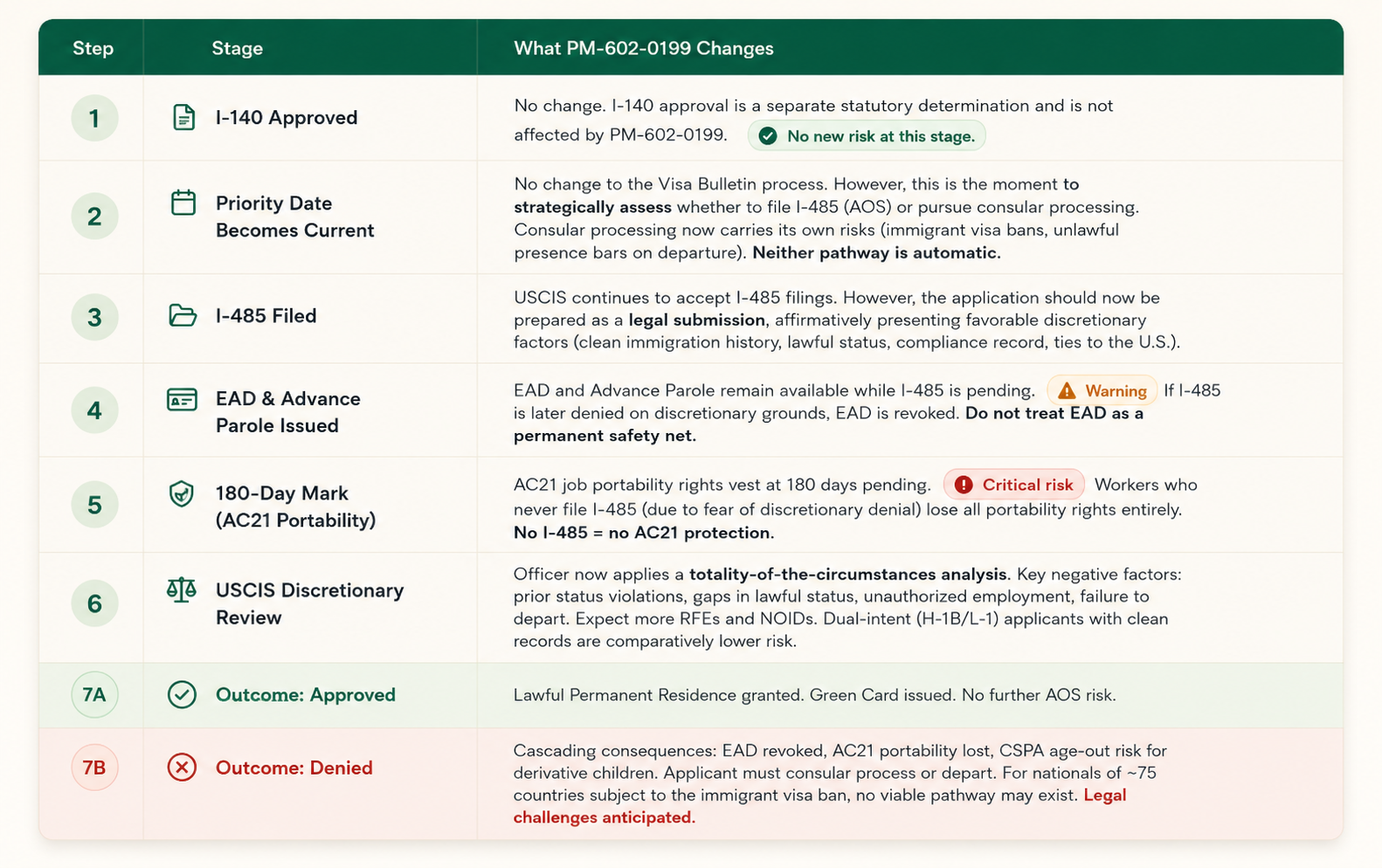
How the New AOS Policy Affects Your Case: A Step-by-Step Overview
Under PM-602-0199 (effective May 22, 2026), USCIS officers must apply a discretionary analysis at each stage below. The process has not changed, but what officers look for at each step has.
If you have questions about how this policy memo may affect your case or your organization’s sponsored employees, please contact our office. We will continue to monitor developments and will issue further guidance as USCIS releases additional category-specific guidance anticipated under the memo.
This alert is intended for general informational purposes only and does not constitute legal advice. Please consult with an attorney regarding your specific circumstances.
[1] “U.S. Citizenship and Immigration Services Will Grant ‘Adjustment of Status’ Only in Extraordinary Circumstances,” by USCIS, https://www.uscis.gov/newsroom/news-releases/us-citizenship-and-immigration-services-will-grant-adjustment-of-status-only-in-extraordinary